Friday, July 17, 2020

Pandemic Racing...on Strava


In the spring, every 5 days or so, the listserv would light up with “What is going to happen with racing this summer?”  People bare their souls about the disappointment of missing a spring race they were so pumped for. Others weigh in with not so expert opinions on how the world for us will change to hill climbs and ITTs. Rather than wait for the race, practice bringing it to you...with Strava. 

I did this last fall, and it is totally applicable now.  I picked a Strava segment I was close to getting, or where I was close to a breakthrough. I adjusted training on a micro cycle level, and picked a day to go after it. Normally, I would be out on a ride and go after the segment. But in this case, I drove to the spot like I was driving to Look Park in Northampton. I picked a start time to mimic the time discipline of a real race.  I fueled and hydrated. I parked and setup my Feedback Sports Omnium trainer. I got the race wheels out and pumped them up to the right pressure. I got the race kit on, and began the warmup. I have a pretty basic warmup that is 15-20 min long. I spin, I ride a little tempo, I do some 30 second efforts at VO2, a 5 minute near threshold piece, and then a short spin. 

Up until this point, this exercise is a great way to test out your warmup without having to pin on a number and wait in line to get it. You can refine and double check your packing list. If you miss your self designated start time, ask why, and evaluate. Because Look Park is going to open at some point, and you need to be ready. 

So right now in the process, you are in race mode. You have been missing this, and here is a barometer. Hit the race line with focus. Know the pace and power you need to hold.      Get after it, just like it is race day...but you are alone. 

Now at this point some reading this are rolling their eyes. “Strava KOMs...ugh.”  But while it is easy to wave a dismissive hand in Strava’s direction, it is a solid measure of performance that can’t be duplicated.  Concrete barriers and goals are what most effectively drives us.  Push yourself to the finish and then evaluate the result. Did you get a PR?  Did you sustain power/pace/HR? Determine either yourself or with your coach where there were gains and where there were gaps. 

There is no doubt that we all like racing. While it is currently in a different form, Strava allows us a good benchmark to apply some structure. And have some fun. Challenge friends, pick a few long segments and make a stage race on total time. Or even, some of these variations:

The road race: pick two segments on a 2 hour ride, one in the middle and one at the end. Simulate getting into the break and going hard for the finish 

The repeat: do a segment that is in a short loop multiple times and see how you gain or fade 

The Cat 5: start your ride with little or no warmup and go for a segment out of the gate. Then ride a loop and do it again.

The practice TT: don’t be shy, put on all the TT gear (wheels, skinsuit, helmet etc) and do the local Thursday Night TT course. Who cares if someone is like “What??” when they see you. It’s the pandemic. How else are you going to ride that Shiv with a solid disc?


Again, these efforts will give you a goal and a benchmark.  They will add some spice and fun to your training, and even if for a brief few hours, your body may feel like it’s Labor Day in the BTV and the crit is coming up. 

Monday, May 18, 2020

Adjusted Expectations

Every vacation, a part of me sets up this plan, to attack a weakness. Because of logistics, it’s usually a run camp. Our family regularly heads south for Feb and April vacation and I develop this elaborate run surge in the warm weather. I won’t be working, I tell myself, I can get the miles in. Sound familiar?  You think that you can just show up in a new place, and disappear for long runs. But inevitably, it’s vacation and the will of the people, and the purpose of the vacation in the first place—to relax—throw a wrench in the plan. Such is life. 

Now taking a break on vacation and actually relaxing, is a really good thing. It’s something we as Americans don’t do enough of some say. There are a myriad of reasons for that. But, it always seems like “run camp” fits with relaxation. I have tried this many times over the past 10 years, with  less than 50% total success rate. And when it isn’t successful, you can come home feeling guilty and sensing you squandered something. 

But, let’s put this in perspective.  One of the good things about some vacations is the unstructured time. A little extra rest, and a chance for the body to absorb training and adapt. Running, biking, and swimming are in your blood though, and not doing anything is usually not your favorite. 

After years of trying to surge on vacation, this year I tried to set the time up as an active recovery week with shorter runs to feel like I did some work, but a lot of flexibility to actually relax. Instead of using the week to build to a long run for the season, I ran short, 2 miles, and did more strides and a short core set. Done in a half an hour before the family even knew if it was sunny or cloudy.  Since I normally run 4 days a week, running 7 days in a row was a mini surge in itself. Expectations were lower, and the stress of fitting it all in were also lower.  

I ran in the morning some days, and in the afternoon on others. It all depended on how it fit. One or two days, I went a little longer. Another bonus, when you only need to go a mile or two down the road, you can easily find a route. In this particular vacation, I found I could run well over two miles either way...on the beach!!!  Bonus: I found a washed up 80s Russian rocket piece!

So, when planning a vacation, set the expectations right: relaxation, family, training. Realize it’s a new place as finding elaborate routes may be hard. Reduce distance, and absorb training. Relax and explore the new place with your family. After all, it’s a vacation. 

Postscript:
I wrote this in late February after a trip to Belize. Then, COVID-19 hit the US and things changed. However, I feel that this perspective applies now, and in the future as things open up. Maybe as restrictions lift, you feel more comfortable getting out and can adjust expectations. Don’t try to ramp up immediately or feel the need to catch up on missed training. Just get out and do something that feels good. During these past few months, one of my most pleasant surprises was the “one minute of core” idea. After each ride, I did one minute of either crunches, planks, inverted leg lifts, anything. A week in, things got into a rhythm and it was evident it was working. I followed Leah Kirchmann on IG and she had daily stories of what she was doing for one minute of core.  So, in the past few months, I’ve had pleasant surprises in the time of overall darkness that I will carry with me...forever. #danforthfamilyfitness

Monday, April 22, 2019

The Mantra

When I started to really race and move up in category, I got totally into it. I wanted to race all the time. I wanted to get podiums and wins.  I worked on my physical training, got a coach, and settled into routines and healthy habits. See: https://h-factor-training.blogspot.com/2019/03/habits-routines-and-superstitions.html?m=1 

As I progressed, I started to eliminate variables that were working against performance and wins.  As a logical next step, I started to work on the mental game and putting myself into the right frame of mind.  Racing is never a walk in the park. If it was, it would be called “easy recovery day”. But it’s not. It’s racing. One of my favorite quotes from Kevin Bouchard Hall is “cycling is about pedaling when no one else wants to”.  

To that end, one of my first breakthroughs was when I started to just tell myself “ten more pedal strokes” when it got hard and I was feeling like I was going to pop.  After doing this a few times, and having it work some of those times, I realized that in most cases, the whole field is racing hard and chances are, if you commit to ten pedal strokes, a majority will only commit to 5 and you will stay in the group. 

Cycling in general is a pack sport.  You don’t always have to beat everyone, you just need to stay in the pack and conserve energy until the critical turning point of the race and then commit. Yes, there is a lot of training and preparation to get you to making the break, but don’t count yourself out before it begins without a positive outlook.  For me, the next phase was the mantra. 

A mantra is a phrase that athletes or humans in general use to focus positively on the moment. It helps to center you and keep you moving towards the goal.  A phrase that calls out the few characteristics that you need at that moment to stay in the fight. 

For me, that phrase was “GT6”. I made stickers and put it on my stem. When I was concentrating on crits, it was what I visualized in the last few laps to stay positive and stay competitive. It’s components?
G: get on up. Get motivated and keep in it
T: They hurt just as much, or more than you do
6: sixth place or better in the last lap or turn. 

These kept me positive, kept me moving, and reminded me to be in position. Think about times when you body is about to crack and you just need a little bit. How many times have you given up only to be 10 feet off the back and unable to close but be so close. Maybe a way to focus here is to distract. Distract with positive reinforcements of simple things to get through the moment. 

Fast forward 20 years, and there I was, at the corner of College and St Paul, in 5th place, and thinking to myself “let’s get this done, GT6, and I feel pretty good right now!” I was shocked at that point how visual the feeling of being ready was as I put that simple check phrase into my psyche and got ready to let it fly. I swear at that moment, I relived the quote of Todd Cassan and could nearly breathe through my nose I was so ready. Three turns later, I was in position and let it fly. And it was glorious. 

Find your zone, find your mantra, and let a positive outlook take your further.  Analyze some negative habits or opportunities for growth where a small amount of positive visualization can get you through the pain. Positive visualization is almost like “free speed”. Used properly, it can be the difference in making a positive outlook. Not used at all, and you will never know the benefit. 

Sunday, March 3, 2019

Habits, Routines, and Superstitions


Yes!!! Everyone has some or all of these. They provide structure, drive, and insecurity!    I have been racing for many years and seen many many different approaches to competition and training.  Observing some is a learning experience in both positive and negative aspects. 

Routines
Routines are specific orders of events that you go through to be ready for the day or a race.  Routines have macro and micro steps. A macro or high level routine helps you to have structure in a fast moving lifestyle so that all of the details are attended to. Micro routines are things like how you get your kit ready for a ride or race, when you make or organize your nutrition, and the order you do things in your day. 

I have a race day routine that works for me. I know after hundreds of races the tangible things that have worked and what I have time for.  When to arrive, when to get my number, when to pre-ride, when to get to the line. Enough routines and they allow you to adapt when the curve comes.  Traffic, car trouble, bad directions, etc. You will know what you absolutely need to do and have the muscle memory to do it, even if you need to skip a few steps.  My truck once died on the way to a race. I limped it to the house where I was picking someone up. Changed a flat on their truck, drove to the race, had time to ride from the start to the first pit.  Crossed my fingers and got fifth with most horrible no-warmup legs. But I lived!!!

Habits 

Habits are learned behaviors that usually result from a desire to change. They take some time to develop and can sometimes come and go.  We all know there are good ones and bad ones. Good: eating a healthy varied diet a good portion of the time, good sleep patterns, getting workouts done in a part of your day that works.  Good habits are generally lifestyle driven with a long term goal in mind. Things like progressing to a Cat 3 cyclist, competing at a high level in age group racing, or even maintaining a healthy weight and blood chemistry.  

Habits are linked with routines at their start sometimes. I remember 20+ years ago I really wanted to do my workouts early in the day. Get them out of the way before work so a changing work schedule—read crazy boss!!—didn’t force me to ruin my plan. It was hard. But then I bought a new car. I had a tandem driveway and I didn’t want my landlord to have to move the car. So I would get up early, move the car and then go for a ride. It’s funny to think that initially, the desire to ride wasn’t all it took to get going. Add one more thing and the motivation kicked in.  Look for these added catalysts to help yourself out. 

Superstitions

Superstitions are somewhat illogical behaviors we carry out to create a perceived advantage through their existence.  They don’t often have a real basis or history. But, in most cases, they provided some response in a particular case and the success or failure was pinned on that behavior. An example is a former teammate of mine who had to have three chocolate munchkins from Dunkins before every race. Regardless of how late we were arriving to the race after driving around trying to find Dunkins.  Think about that. He had to have this snack counter to all good ideas about nutrition and it stressed him out to not have it.  Analyze the true benefit/reward of your preface or routine activities. Do they make sense?  Are they illogical?  Reevaluate based on your answers to these questions. When in doubt, bounce it off your coach or a friend. 

Bonus: Streaks!!!

Oh my, think about how often streaks come into play. Zwift gives you a badge for 14/28/76 straight days. You want to ski or ride for seven straight days in the winter. You want to get 365 racing days before you complete 10 years of racing.  These all have a patina of cool, but have a foundation in an external stress that you don’t need any more of.  If you are tired or have another priority, a streak may push you to make a poor decision. Yes, there are cases when say you are at a camp and you want to maximize work, but life is life. Keep it in balance and make sure the streak doesn’t share some of the bad behaviors of superstitions above. 

Racing and/or succeeding in a healthy lifestyle are the culmination of many factors. The training, the nutrition, and the balance. Get into good habits and routines, and they will complement your training. If you struggle with metrics or results evaluate not just your training, but the whole lifestyle and look for areas to make incremental changes with leveraged rewards. 

Tuesday, February 12, 2019

Get going, if only a little bit


It’s early February. If you are in New England, it’s like Ben Coleman says: “I’m ready sort of for Winter to walk away”. But, we love Nordic, Backcountry, and our many resorts so we put up with it.  But if you want to enter the bike or triathlon season with some measure of skills, you need to be doing some work in these cold months specific to the sport. 

That being said, as an endurance athlete, go back to the first paragraph and remember the Nordic part. I absolutely love XC skiing. If I could live on Trapp Hill Rd and ski out the back of the house every day I would. A little non specific endurance activity goes a long way. Especially when it is a sport that uses every single part of the body. If you run and bike a lot, the sideways skating motion strengthens your hips and opens up the stride like nothing else.  Skiing once or twice a week makes a huge difference for me. 

But, you are still going to be riding bikes in the spring. So, sport specific activity is key starting in February to be ready for spring. There are a few avenues you can take. But each start with one basic tenet: you don’t have to do everything, just do something.  

First option: get on a trainer or some rollers and ride at least an hour, at least four times a week. This can be before breakfast early or when you get home from work.  I find it’s best early because no one in my house is up and therefore no one is needing my time. It’s mine. After work, you have activities and meals to make and people may be counting on you.  Ride easy at first and then add some intensity but don’t hammer all the time.


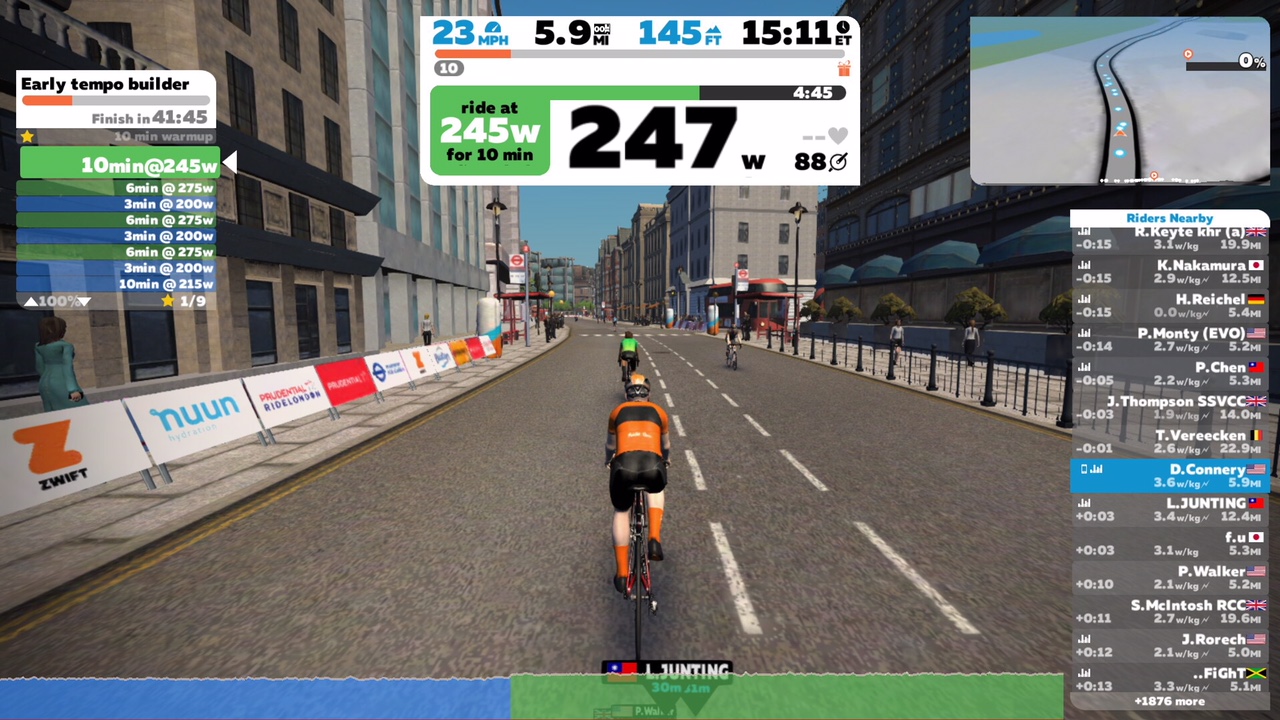
Second option: get a smart trainer and ride at least an hour, at least four times a week, and ride with the pack. Do some events, maybe pick a few workouts out of the Zwift workout list. Try a few things but mostly it’s about being aerobic and getting the legs moving.  As a bonus, pick a weekend day, or another day that works and ride 90-120 minutes.  As a goal, check your weight at the start of the commitment to ride and work to see it come down reliably little by little every few weeks.  Note:  there is a wide spectrum of Zwift users.  I love the Zwift!  I see it as a great tool for riding undulating terrain, and doing workouts where power levels can be held constant.  One of my favorites is when you are set to ride X watts, and you start to daydream or lose focus, and your cadence drops...it ratchets up the resistance and maintains constant power even at a lower cadence.  It does that by increasing the load.  You quickly refocus and get back on the horse!  For performance testing, it is also the measure of consistency that is key.

Third option: get some professional guidance. With a smart trainer or rollers and a power meter, look up a coach and either get some personalized coaching or an online plan from a coach. This will be comprised of efforts that are well tailored to being ready for spring. You will get help analyzing key power metrics which will then guide you through early season development on a path to success. 

While some of these options may be a little bit more than you are ready to commit to, remember the key idea: do something and do it regularly.  Commit to ride 4x a week for two weeks and make it a habit.  It doesn’t have to start with a lot of volume, you just need to do something rather than wring your hands about what you may be missing. 

Aerobic activity will prepare you for the upcoming season and required race efforts. The aerobic efforts will burn calories and get you toward race weight.  Make it simple, or jump in with both feet. You decide.  


Thursday, April 12, 2018

How the race was worn


Every spring I start going outside and I forget, “what do I wear today?”  So after years and years of trying to remember,  I recorded these layers over the past year and made some tweaks. It is so easy to overdress and be miserable. These are geared towards racing, so if training long, maybe consider going one range colder. That way, at lower intensity you can stay warm.  As always, experiment with what works best and customize.  Layers below work best when using Verge clothing.  They make great stuff using modern patterns.  There are two exceptions noted below for very specific garments.  But buy Verge whenever you can!!

Above 65: dry or wet: short sleeves and shorts, base layer. Maybe a vest and arm warmers in the pocket if rain gets cold on descents
55-65: Dry: shorts, SS jersey, base layer and arm warmers, vest in the pocket maybe if you are feeling chilly. 
55-65: Wet: same as above but add light leg warmers if chilly. 
47-55: Dry: jersey, shorts, base layer,  arm and leg warmers, vest, maybe oversocks/shoe covers
47-55: wet: leg warmers, shorts, long sleeve jersey with long sleeve base layer underneath. Vest or jacket
40-47: Dry: leg warmers, shorts, long sleeve jersey with long sleeve base layer underneath. Vest or jacket, booties/shoe covers, maybe buff/gaiter
40-47: wet: arm and leg warmers, long sleeve base layer, LS jersey, jacket, long gloves, thick booties, buff/gaiter
Sub 40 or Rasputitsa: Gabba Jersey LS baselayer, shorts with base layer underneath*, leg warmers, booties, long gloves, buff/gaiter 

*Many years ago, I bought a few pairs of baselayer shorts that were sewn inside out so the seams weren’t against the skin. They were made by Andiamo, and they provide just a little more insulation without bulk. 

Never put on a fleece as an outer layer, as it provides no insulation unless in still air. Still air = no forward motion!  This is actually part of old Polartec marketing. “Provides best insulation relative to bulk in still air” or something like that. In most cases, it would just absorb moisture and make you colder. 

Make things modular if on the bubble. Allow for stuff to be removed if it gets too warm. That’s why leg warmers vs tights are key. Vests that can tuck into a pocket if required.  Look at the weather, especially if you are out for 4 hours starting at dawn.  Temps can change, and the new weather tools can really help identify how things may change.  This is where armwarmers and vests are key.  Manage pockets thinking of this.

Most of all, enjoy.  Conquering the weather makes you feel alive.

Friday, February 2, 2018

Zwifting for fitness


So I just dove into the electronic trainer game full force. I bought a Cycleops Hammer, and took the rear wheel off my bike.  Now before everyone is all like “trainer riding is lame, ride outdoors!” I give you exhibits 1 and 2: it’s -6 F out and my kids have activities at every moment of every day. Riding in the AM on rollers for me has been the way I get things done for a long time during winter. I have been training with power for about 17 years and have been used to that feedback, augmented by metrics in TrainingPeaks. 

But electronic trainers and Zwift etc are a pretty cool development. And it isn’t that you can ride through a virtual world and have the resistance change while going uphill. (Believe me, it’s only been a month and if I see that climb to the top of the cable car once more...I might lose it).  Rather, putting workouts into Zwift and having the software control the power output in erg mode is where the real benefit lies.  You can connect your TrainingPeaks account and it’s designed workouts with Zwift. If your coach assigns warmups, tempo, warmdown etc in a workout, “erg” mode in Zwift allows you to have the power controlled. 

I have ridden long tempo blocks and held a reasonably consistent average power. I have watched my Power/HR metric and felt good that it was staying below 5%. But Zwifting a long tempo block is another level of difficulty.  When it says: Ride “X” Watts for 20 minutes, it doesn’t know you tire at the end of the set. And since power is proportional to torque, and torque is affected by  cadence, when you get tired or lose focus and drop cadence, the electronic trainer ups the resistance to increase torque and keep power constant.  This is motivating because if the resistance gets too high...you are grinding it out at low revs!  Watching a power number and keep it roughly at the average yourself is not the same as a machine constantly making it exactly obvious that you will ride “X” Watts and that only. 

So this is where the real benefit of winter training on electronic trainers becomes so much better for getting you fit. When you are pushed to complete sets on target and to the end, you build muscle endurance and increase conditioning. The intensity of the set further drives this home. Riding 10 min at threshold there is more opportunity to fade vs 49 min at aerobic or easy pace. 

Mixing this strength work up with regular roller rides at lower intensities as well as open rides on Zwift where you can ride with others and sometimes race them is a good diversion. And always, there is the 4th and 5th options: riding on the road when it’s safe and fat biking the local trails.